The Timberwolves have enjoyed their most successful stretch in franchise history over these past four seasons, including two conference finals appearances. Over those years, the roster has had some turnover, but the approach to winning remained.
That approach appears to have hit a ceiling to Wolves leadership. As a result, they have gone in a new direction, with a new vision on how they should win games.
And, I think I see what they’re doing.
An excess of on-ball creation
That’s a weird term, but the concept is simple. I’m talking about players who can generate a bucket for themselves or others when they have the ball.
If there’s one commonality I can draw on the recent roster overhaul, it is that there are so many players who can do this.
Ayo Dosunmu, acquired in 2026’s trade deadline, showed us he can self-create at a high level in his playoff run with the Wolves, scoring a whopping 43 points in game 4.
Ayo also has a feel for making the simple play, generating good shots for others.
Terrence Shannon Jr. had a similar experience in this series, closing out game 6 with 24 points after several injuries to the Wolves back-court. He has a powerful first step that can consistently penetrate a defense.
Anthony Edwards had this to say at media day about Jonathan Kuminga:
We’ve been playin’ him for 3 or 4 years and we never could stop him
The Wolves also invested in Jaden McDaniels’s ability to create with the ball, giving him ample opportunities last year. And it’s paid off, in big moments.
And we all know what Anthony Edwards and LaMelo Ball can do with the ball. Though, if you’d like a reminder, you can check out my recent articles on them:


Is it too much?
This roster has so much on-ball creation that it can be considered a problem. There’s only so many minutes to go around, and even fewer that you can touch the ball. Can these players be maximized in an environment that is over-saturated with on-ball creators?
It is a fair criticism. Players tend to be evaluated on their production, such as the points or assists that they collect. It is a zero-sum game, a player like Kuminga will naturally have less opportunities with the ball when Ant and LaMelo are higher in the pecking order.
I think the Wolves are asking a different question. How often can they partner on-ball creators in offensive actions?
Ant’s defender, Scottie Barnes initially helps Randle’s defender, Jakob Poeltl, contain Randle’s drive. That initial help sets up a handoff, which generates an easy bucket for Randle.
These advantages were created because both players are able to draw help defenders with the ball in their hands. Let’s look at another example.
Using on-ball creators as screeners on the perimeter creates switching situations, and often confusion. Here, Kon Knueppel screens for LaMelo Ball. LaNelo’s defender fights through the screen, while Kon’s defender switches onto LaMelo. That gives Kon a shifted defense to attack, and an easy layup.
This isn’t a foreign concept to the Timberwolves, as they’ve been adding and investing in on-ball creation over the past couple of years. Still, it was common to sense a lack of it on the roster, especially when Julius or Ant went to the bench.
I love the idea of Rudy Gobert, Jaylen Clark and Jaden McDaniels terrorizing offenses with their defensive prowess. But there is a burden on Ant here to carry the offensive load. And it is a tough road to travel when a defense can send extra help due to having multiple non-creators on the floor (Clark and Gobert).
What these young bloods have to understand is this game has always been and always will be about buckets.
Bill Russell
The game gravitates towards players who can create buckets. The Wolves are betting on a surplus of creators creating a surplus of advantages. I like that bet.
Eager to help
The Rudy & KAT era
Rudy Gobert joined the Timberwolves in 2022, giving birth to a new era in Minnesota. Pairing him with Karl Anthony-Towns and Jaden McDaniels created a plethora of size for opponents to deal with.
In this example, the Grizzlies are running a double-drag look for Ja Morant. His defender (Conley) is screened, and is in chase mode. KAT’s assignment, Jackson Jr. (JJJ), ghosts the screen, diving to the rim. KAT goes into a drop, deterring Morant’s drive. JJJ gets a lob, and here comes Rudy Gobert.
Here’s another example.
Jaden McDaniels fights through a screen and recovers to sharpshooter (and former Wolf) Malik Beasley, deterring his shot. Beasley drives past, and sees Rudy Gobert in place to prevent a lob. He puts up a floater, which is rejected by McDaniels, as is the following putback attempt.
Another note - If we look at the off-ball assignments, we can see that the Wolves have the luxury to have KAT on the perimeter for any pass to Giannis. They don’t need KAT to help off of him for a drive, as they have Gobert at the hoop.
One more example. This time, without Gobert on the court.
In these bench units, KAT would often shift into Rudy’s role as the primary drop defender, while Naz Reid would slide into KAT’s role as the primary helper. That combo was not as potent as Rudy/KAT, but it still packed a punch, especially with capable defenders like Nickeil Alexander-Walker and Kyle Anderson also sharing the court.
Transitioning to Julius Randle
Unlike KAT, Randle was more of a traditional 4. He was still a large player, at 6’9 and 250 lbs, and the defense was still a good one with him on the roster, finishing 6th and 8th respectively. But it lacked some punch, particularly with Rudy off of the floor, where they asked Naz Reid to be the 5.
Naz was a center when he was drafted, but has since transformed his body into a wing archetype. That works when defending as the 4 next to KAT or Rudy, as he can contest and recover. But as a 5, he lacks the positional size to compete with the bigger bodies.
Still, there were some interesting wrinkles added to the Wolves defense as they attempted to navigate Julius’s arrival. For example, they invested in switching, which has shown improvements, such as this example where Naz bothers the speedy De’Aaron Fox.
Another interesting wrinkle was a zone look, centered around Jaden McDaniels in the middle as a conductor.
These wrinkles are good additions, and a deep bag of defensive schemes that you can use in a playoff setting is important. Still, these additions represent the fact that the Wolves were no longer able to rely on size as a unique advantage.
The new vision
The departures of Naz Reid and Julius Randle in the offseason has left the Wolves even smaller in the front court. This begs the question, can the Wolves construct a championship defense without that size advantage?
To answer that, I think the Wolves have looked to the Spurs for inspiration.
Who is Victor Wembanyama’s assignment on this play? That would be Dort, who is in the corner. And Victor ends up on the opposite side of the court to get the block.
Are the Spurs ignoring Dort? Not quite. Look at how Champagnie is positioned behind Victor. His responsibility on this play has grown, as he is now covering a kick-out to Dort or Williams. This allows Victor to roam off of his assignment, and contest any drive that comes his way.
Let’s check out another example of this.
Victor is still roaming off of the corner here, and Harper is in position to protect the skip pass. A difference here - look at Champagnie. He has also acted as a helper. Shai Gilgeous-Alexander (SGA) sees this and swings the ball around to rotate. Watch Harper rotate back to the top of the key, leaving Champagnie to rotate all the way back to the left slot. He gets there, allowing Victor to recover to the other corner and contest.
There are a couple of themes here. First - the Spurs have coined this as a “one man zone” for Victor. The goal is to allow him to protect the rim more often.
Second - the Spurs often double-down on the additional help, sending additional perimeter players as deterrents towards creators.
Look at how eager Champagnie is to deter this drive from Shai, with Victor in a drop behind him. They have thrown 3 bodies at SGA on this drive, and happily recover back when SGA offloads the ball.
This scheme has a considerable cost. It requires a defense willing to “fly around”, living in a rotation. It also demands the world of the rim protector, who must deter drives from every direction while also recovering back to his own assignment.
Few teams are constructed with these components. I believe the Wolves are now one of those teams.
They have Rudy Gobert, who has spent an entire career as a one-man show at the rim.
Ant and Jaden have experience with a heavy-rotation scheme, from their time in the “high-wall” defense in the 21-22 season.
Kuminga may not have the size that Randle or KAT had, but he is one of the league’s best athletes, and can cover a lot of space quickly in tough spots.
I suspect that the Timberwolves will be asking their defenders to lean into a heavy-rotation scheme. There are risks to that, such as exertion of your defenders, and manipulation by good offensive strategies.
In this example, the Spurs attempt to trap SGA near halfcourt. SGA swings the ball, which forces Castle to sprint from halfcourt to the corner. Chet has a wide open 3 as a result.
Even so, Wembanyama and the Spurs were able to post the league’s 3rd best defense. And I think it is a model that adapts well to the Wolves, considering their personnel.
Final thoughts
I’m excited to see this new iteration of the Timberwolves. Chris Finch and his staff will be able to experiment with a lot of concepts that involve multiple creators, and invest in a defense that can fly around in front of one of the league’s best rim protectors.
It remains to be seen if this team can soar to new heights. But there’s a buzz that is hard to ignore. And it has me craving for more.
Film Salad supporters
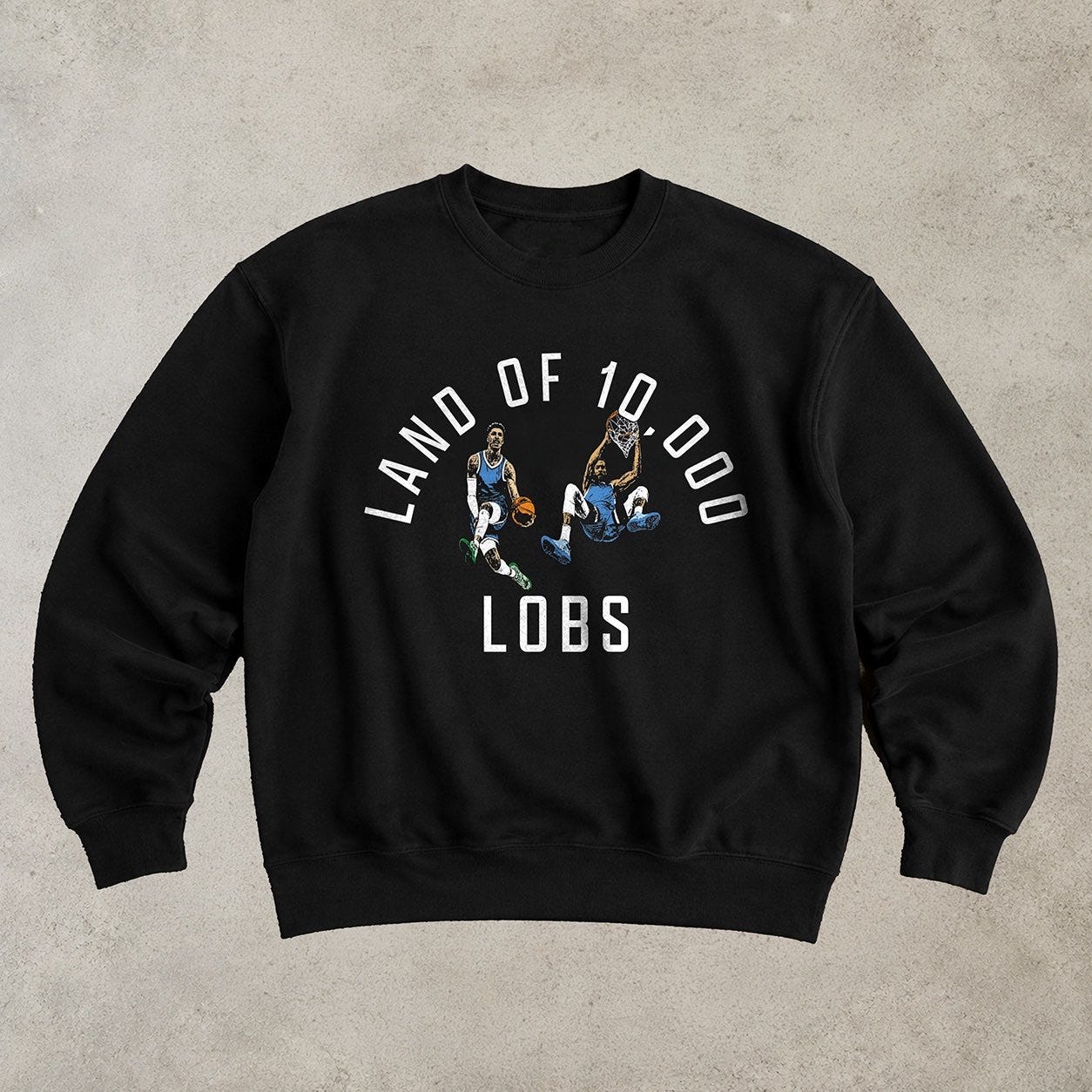
As a card-carrying member the die-hard Minnesota sports community, I find that my wardrobe needs to match my enthusiasm. That’s why I am partnering with SixOneTwoTees for this upcoming Wolves season. You can use the promo code SALAD for 15% off of your first order.
If you liked this, you’ll like these
Wolves Questions Entering The Season with Britt Robson - Dane Moore, The Dane Moore NBA Podcast
Timberwolves’ crusade against flopping may be losing battle - Jace Frederick, The Pioneer Press
Anthony Edwards & LaMelo Ball Timberwolves Interview | Speak on Trade, Vibes, Chemistry, Friendship - Minnesota Timberwolves
Can Ayo Dosunmu Become Even More Valuable To Minnesota? - Jake Paynting, Howls and Growls